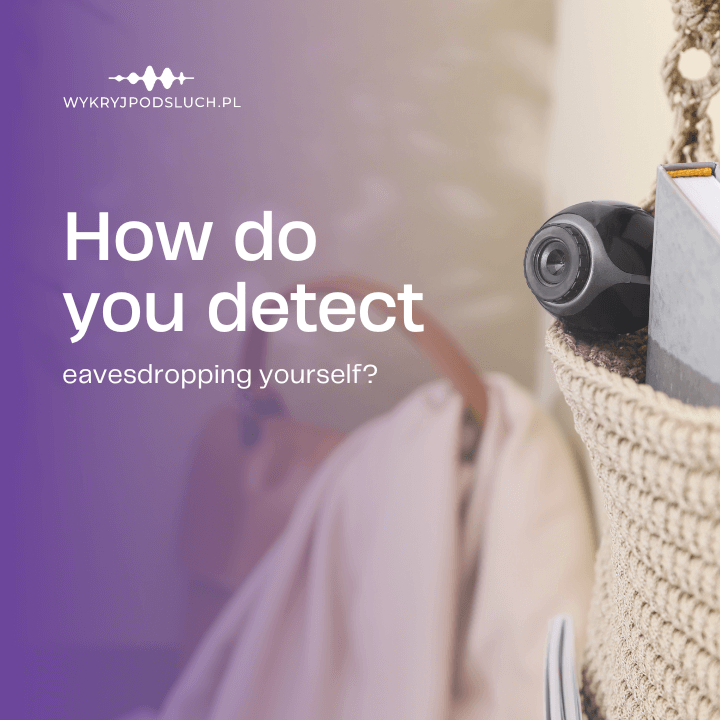
A great many myths have grown up about eavesdropping. These concern both the technologies used for eavesdropping, the technical parameters and the very appearance of surveillance devices.
Many times during interviews preceding anti-wiretapping investigations, we are confronted with the question ‘How does wiretapping work?’
The answer may surprise you, because the image created by thrillers, in many cases, is far from reality.
Hollywood wiretaps
The standard film bug is a tiny lozenge-shaped device, often fitted with a small red LED and an antenna. Movie bugs have a range of super functions, including even self-destruction with a spectacular explosion. The makers of film props do not care about reality, otherwise Agent 007’s bugging gadgets would completely lose their appeal.
The most common misrepresentation seen in Hollywood productions is the working time of the eavesdropper in relation to its size and mode of operation. Actual eavesdropping devices have to be powered somehow, and the amount of power supplied necessary for operation is dependent on the technologies used. A miniature dictaphone will require less power than a transmitting eavesdropper, which in turn will require less power than a model using GSM connectivity, and certainly less than cameras streaming live video with sound via WiFi. While the microphone itself and its circuitry can be very small (the whole may not exceed 4×2 dimensions), adding a battery to it can increase the size of the eavesdropper many times over.
Popular eavesdropping solutions
In the real world, there is a gradual move away from so-called bugs, i.e. small analogue transmitters that send information by radio. Their place is being taken by the increasingly popular sound recorders hidden in everyday devices. Such dual use often remains unnoticed until the arrival of a professional detection team.
Particularly effective are eavesdroppers camouflaged in devices with permanent access to electricity, as they do not require ‘servicing’ in the form of changing batteries.
Actual operating time of wiretaps
A dictaphone can record for up to several weeks and wait in a dormant state for up to six months. Analogue radio eavesdroppers with battery power will send data from a few days to a month. On the other hand, devices that record both video and audio and use WiFi will last for a week.Note that supplying mains power will have the effect of lifting any limitations in this aspect.
How realistic is it that someone will plant a wiretap?
Ever-lower prices and wide availability make cheap spy devices that record or use digital data transmission a real threat. In practice, anyone can afford to buy a miniature camera that sends video and sound via WiFi. Its cost is only a few hundred zloty! In addition, the administrator of such a device can be located at any distance – even in the opposite hemisphere, while retaining the ability to view and eavesdrop live and remotely manipulate the collected material.
It should be noted that software solutions discreetly ‘sewn’ into smartphones, tablets or computers are also popular. Spyware can eavesdrop and collect all the activity of an unsuspecting victim indefinitely. Simply checking installed applications or active processes may not be enough and it may be necessary to call in a specialist.
If you already know how eavesdropping works, perhaps you want to find out how to detect it? Take a look at our post on eavesdropping detection.