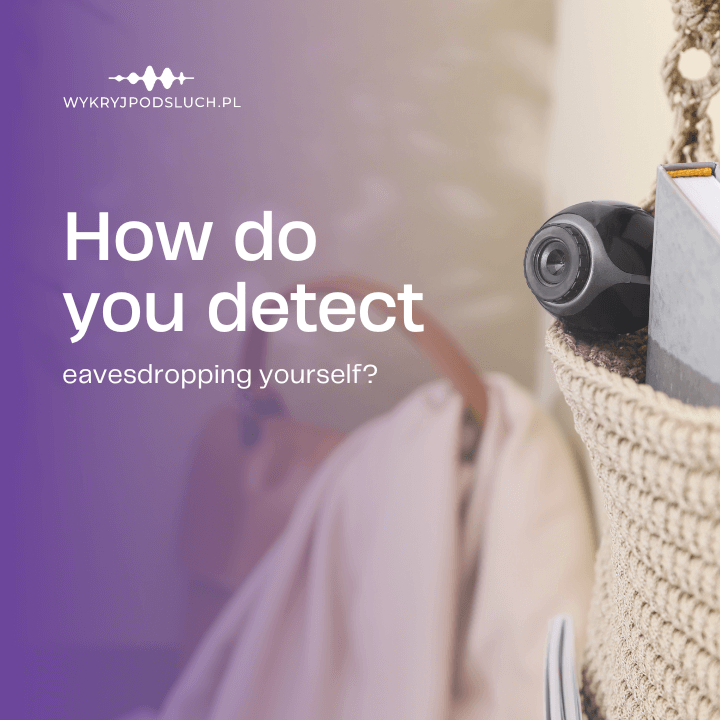

Smart technology is developing rapidly, giving us a wide range of spy devices. With one word eavesdropper or bug, different types of eavesdroppers can be described. They differ from each other not only in their shape or form of camouflage, but also in the technologies used. The use of the chosen type depends mainly on the freedom of access to the premises and the physical and technical conditions of the facility being invigilated. Eavesdroppers can send information by radio or wire, record it on a storage medium or send and record it simultaneously.
What types of wiretapping are there?
- Currently, the following wiretaps are available on the market:
- – analogue radio (bedbugs)
- – digital radio,
- – GSM,
- – seismic (stethoscopic),
- – wired,
- – software (PCs),
- – landline telephones
- – mobile phones,
- – remote using directional microphones or laser equipment,
- – recorders (dictaphones)
- and others.
It can be seen that some types of eavesdropping are more or less popular, but each has its own use and, depending on the situation, has a higher or lower effectiveness; for example, GSM eavesdroppers function on a similar principle to mobile phones, so they have the same limitations related to access to the mobile network. They are usually small devices that can be concealed in a variety of everyday objects. Remote eavesdropping, on the other hand, uses directional microphones, as well as various types of laser systems, giving the possibility of ‘non-invasive’ eavesdropping from a relatively long distance. Detection of the latter is possible, but requires an experienced team and the right tool.
Depending on the eavesdropping technology used, it is necessary to use other tools to detect different types of eavesdropping. A single tool does not guarantee an effective anti-eavesdropping investigation, which is why it is so important that professional wiretap detectors are properly equipped.
Are you interested in the topic of detection? See what to do if you suspect someone is eavesdropping on you.