
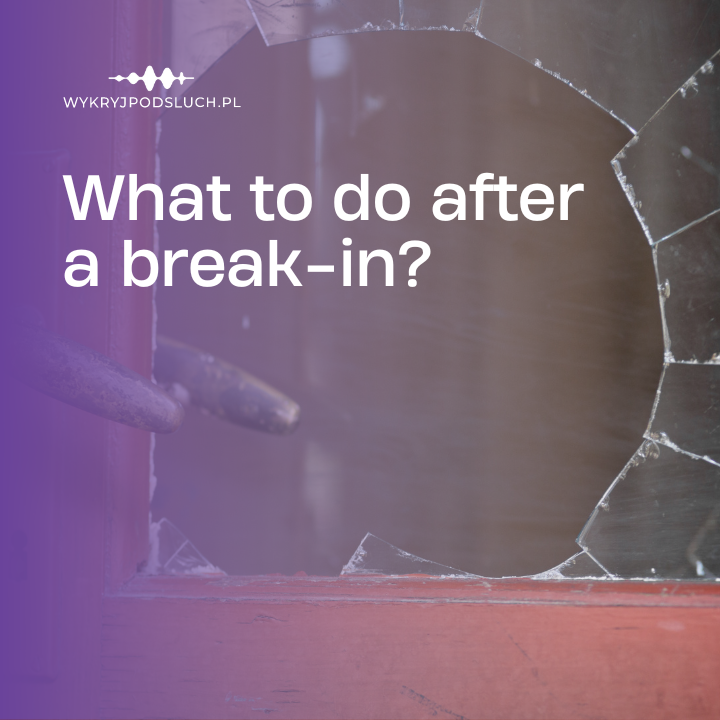
Next to fire and vehicle theft, burglary is one of the most traumatic property events in the life of a statistical person. Victims of burglary often describe the feelings associated with this traumatic event as a loss of a sense of security. They sometimes claim that they have lost their privacy and are convinced that someone could enter their home again at any time. They do not know what to do after a break-in.
How do you know there has been a burglary?
Contrary to popular belief, no valuables need be lost in the home at all – it all depends on the burglar’s aims. It may be that the purpose of the burglary was to take photographs of certain documents or to plant compromising material on the victim.
A burglary does not always leave such obvious traces as a broken door or broken window. Sometimes the only trace is a slightly bent window profile or a hole in the frame that is not noticed at first. The popularity of advanced locks and burglar-proof doors has led thieves to look for other methods of gaining entry. Unfortunately, older locks, such as the Yeti key lock, are still in widespread use and no longer provide sufficient security. A skilled burglar can break through such a barrier in less than a minute – this does not even require the use of force.
What to do after a burglary when the police have already been informed?
Once the burglary has been discovered and the police have been informed, it is important to ascertain whether and what items have been stolen. You can point out to the officers if anything has been moved, etc. Before the investigators visit, you should refrain from tidying up, even if the flat is not perfectly clean – you could do harm, for example, by accidentally rubbing off the perpetrators’ fingerprints. It is also worth taking the opportunity to look at surfaces to see if any dust has been rubbed off in an unusual place. Such a trail may indicate where the burglar was operating. CCTV footage should also be secured, if there is one at the property. CCTV footage can be very helpful in establishing who entered the house and through which way. CCTV can indicate where the intruder looked and what they took with them.
The next step should be to report the damage to the insurance company in order to obtain compensation, for example for a damaged balcony door or stolen valuables.
But, what to do after a burglary when the circumstances and the burglars’ aims are not clear? When nothing has been lost but the victim feels that he or she is being watched or eavesdropped on, eavesdropping detection should be considered.
Checking the premises after a burglary
An anti-robbery check is not the first thought that comes to mind after a burglary, but it is a natural activity to return to normal functioning.
For the technicians performing the anti-robbery check, it does not matter whether they are entering a conference room before an important meeting or checking a flat after a burglary. A reliable, multidimensional inspection together with a physical search will help to rule out the possibility of planting a wiretap or tampering with the monitoring system present on site. In addition, after each wiretap detection service, the client receives a report with post-inspection recommendations. By following the recommendations, the level of security can be increased and the sense of privacy regained.
Also find out how long it takes to detect wiretaps and what an anti-wiretapping test consists of.