
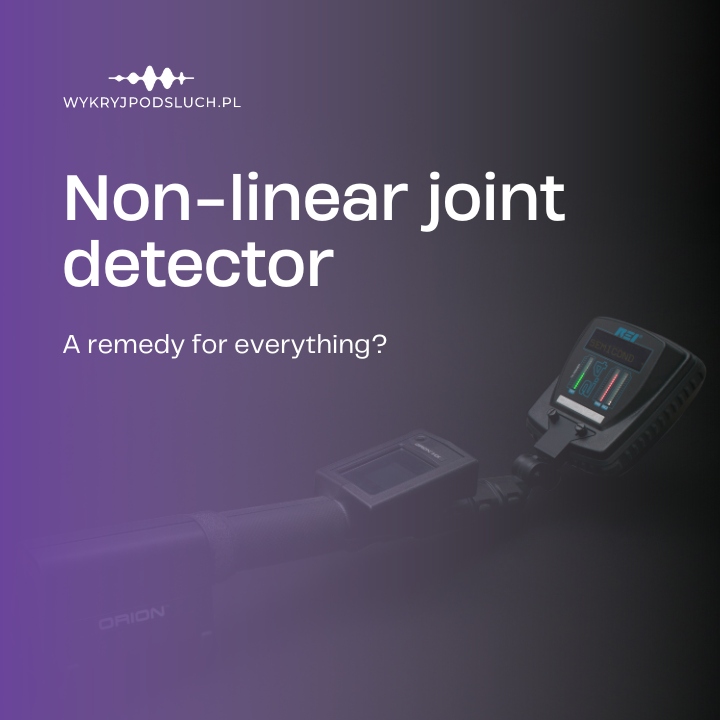
The so-called NLJD (non linear junction detector) is part of every professional eavesdropping detection team’s toolkit. Using the NLJD as a detection tool bridges the gap between spectrum analysers and slow magnetic field detectors. This is a significant improvement to ongoing inspection activities for the technician. Although the use of the detector itself is not difficult, it may require some experience to read the readings correctly.
Interesting fact: The Polish name of the device was adopted with an error, as the word connector in the plural complement is złączy and not złącz.
What is a non-linear junction detector and how does it work?
The NLJD is an active sensing device whose task is to indicate the location of potential natural or synthetic non-linearities in the immediate environment.
For the remainder of this post, let me use some simplifications so as not to go too much into the nuances of physics, but to outline the general mode of operation. It detects natural structures such as joints between different metals, or simply corrosion in metal components. Positive indications of the device for natural non-linearity will be, for example, a container of paper clips, a bunch of keys, rusted areas, sheet metal screws in a sheet of tin, etc.
The second type of non-linearity is at metal-semiconductor (silicon) junctions – in simplest terms, electronics. The device will indicate the presence of even such tiny components as a single diode. And it is this capability that is used in anti-hearing checks.
The non-linear junction detector sends out a radio signal at a certain, precisely defined frequency and then listens for the reflected echo. The reflected signal is altered by the structures it encounters, ‘saturating’ itself with harmonics of the original signal. The detector analyses the reflected signal and images the level of the harmonics using its interface. A reflected echo with a strong second harmonic will come from natural and a third from synthetic objects. It is this signal that indicates an encounter with electronics and is an indication to, for example, take an object apart. The detector itself sends the signal, so it does not matter to it whether the electronics the technician has encountered are switched on or not. Nor does it matter how it works – the detector reveals both devices with and without transmission.
When to use the NLJD?
The non-linear connector detector, as I mentioned earlier, is one of the components of the kit used when detecting eavesdropping. It should be used to verify the presence of unauthorised electronic devices. These include not only eavesdroppers, but also, for example, unregulated memory media, vias, chargers and others. Work with the non-linear junction detector should be planned as an activity before or after an RF spectrum survey, as the NLJD is itself a source of signals and can interfere with the reception of a spectrum analyser operating at the same time.
What are the limitations of a non-linear joint detector?
The main limitation of use is the reach of the operator’s hand and the size of the slot into which the detector can be inserted. Due to the head design, the NLJD works directionally. This fact may cause some difficulties when working on an extended boom, e.g. in Orion 900HX or Cayman ST-402. It should also be mentioned that if the eavesdropper is hidden in another electronic device, the NLJD will not help to detect it. To avoid overlooking an eavesdropper in such a situation, other detection devices should be used.
How much does the NLJD cost?
The non-linear junction detector is a specialised piece of equipment and consequently its price is high. Depending on the manufacturer, the price of an NLJD detector ranges from PLN 35 to 110,000.
Due to the high price, the device is practically beyond the purchasing reach of the average person. The reasonableness of buying a detector just to perform a one-off check of your flat is also questionable. Therefore, a reasonable solution is to use the help of a company specialising in detection. The cost of such a service is only a small fraction of the price of the detector itself not to mention the rest of the kit.
Want to know what wiretap detection is all about? We invite you to read our entry on the subject.